Why calibration matters
NLP interventions are state-dependent. Anchoring at the wrong moment misses. Reframing the wrong content fails. The Milton model can either ease a client through resistance or install something they will resent later - the difference is reading state correctly. Without calibration, every other NLP skill is guesswork.
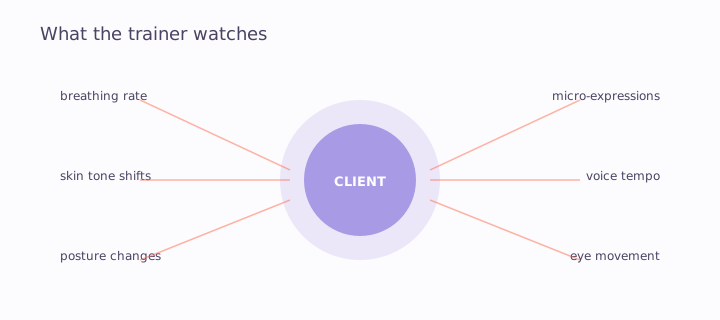
The six primary channels
Breathing
Rate and depth. The fastest signal of state change and the hardest for clients to mask. A held breath, a shift from chest to belly, a sudden deepening - all indicate a state shift.
Skin tone
Color and flush. Especially visible at the throat, cheeks, and forehead. Sympathetic activation tends to pale (blood withdraws from extremities); parasympathetic recovery tends to flush.
Micro-expression
Brief, involuntary facial movements that flicker before the social mask reasserts itself. Easier to read on video playback than live; live calibration usually relies on the after-effect rather than the expression itself.
Voice tempo and tone
Speech rate, pitch range, volume, pauses. State shifts often produce predictable voice changes: anxiety quickens and raises pitch; settling slows and drops it; resolution adds pauses.
Eye movement
Direction of gaze and eye-accessing patterns. Use as one signal among many; the classic NLP eye-cue map is hypothesis, not conclusion.
Posture
Major shifts in seated alignment, leaning toward or away, micro-movements of the limbs. Posture often shifts a beat before the client becomes consciously aware of a state change.
How to establish a baseline
First 2-5 minutes of any session:
- Get the client talking about something neutral - the journey to the session, the weather, what they had for breakfast.
- Observe each channel at rest. Note breathing rate, skin tone, posture, voice tempo.
- Move to a low-stakes question about the work ("So what brought you here?").
- Notice what changes. The first shift gives you both their baseline and a sample of how they show change.
Without this groundwork, you spend the session guessing rather than calibrating.
How to train calibration
- Two-person drills: ask a partner to recall two contrasting memories (one pleasant, one stressful) without telling you which is which. Calibrate from their physiology; guess; check. Repeat until you are reliably accurate.
- Video study: watch coaching demonstrations with the sound off. Predict what is happening from physiology alone, then watch with sound to check.
- Public-place observation: in cafes or parks, pick a stranger and track state changes across two minutes. You will not get feedback on accuracy, but you will train the perceptual habit.
- Live coaching practice with supervision. The trainer corrects what you missed in real time. Nothing replaces this.
Common calibration mistakes
- Skipping baseline. Without it, every cue feels significant. With it, you have something concrete to compare against.
- Interpreting too fast. "She crossed her arms - she is defensive" is reading not calibration. Track the change; interpret from context.
- Projecting. When you are tired, you read tiredness in others. Calibrate your own state first.
- Watching one channel. Most reliable signals are convergent - breathing shifts AND voice tempo changes AND skin flushes. Single-channel cues are weak.
Frequently asked questions
What's the difference between calibration and sensory acuity?
Sensory acuity is the general ability to notice small changes in another person's physiology. Calibration is sensory acuity applied to a specific person - you establish their baseline and watch for shifts relative to it.
How long does it take to develop calibration?
Basic skill comes from 20-40 hours of deliberate practice. Working-trainer level skill (calibrating live during interventions) takes 1-3 years of supervised practice on real clients.
What should I watch for first?
Breathing rate and skin tone. Both change quickly with state shifts and are easier to read than facial micro-expression. Once you can track these reliably, add voice tempo and eye-accessing patterns.
Can you calibrate over video?
Yes, with some loss. Video preserves face, voice, and upper-body posture; it loses subtle breathing and full-body posture cues. Voice-only calls preserve tempo and tone but lose visual channels entirely. Many trainers find voice-only easier than badly-lit video.
Is calibration the same as reading body language?
Related but more disciplined. Popular body-language reading tries to interpret cues into meaning ('crossed arms = defensive'). Calibration tracks change relative to baseline without interpreting; the meaning comes from context, not the cue.
How do you avoid projecting your own state onto the client?
Establish baseline first. Without a baseline, every cue feels meaningful. With a baseline, you have something concrete to compare against. Skilled calibration is mostly disciplined comparison, not intuition.
DIRECTORY
Find a trainer who teaches calibration in depth
Most certifications cover calibration; few teach it to working-practitioner level. Specialty training matters here.