What does VAK stand for?
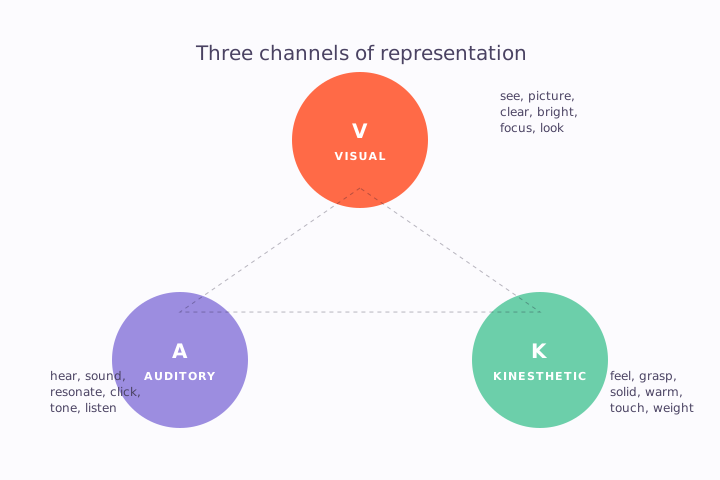
VAK stands for visual, auditory, and kinesthetic. Each letter names one of three primary sensory channels through which people receive, store, and recall information.
- Visual: internal pictures, color, brightness, distance, spatial relationships.
- Auditory: sounds, voices, internal dialogue, tempo, tone.
- Kinesthetic: physical sensation, emotion, movement, balance, temperature.
Some NLP schools extend the model to include olfactory (smell) and gustatory (taste), producing VAKOG. In practice, V, A, and K cover almost all of what working coaches need.
How do you identify someone's VAK preference?
Three signals, watched together:
- Predicates: the sensory-specific words in their language. "I see what you mean" (visual), "that sounds right" (auditory), "I am not feeling it" (kinesthetic).
- Eye accessing cues: the classic NLP map associates upward eye movement with visual processing, sideways with auditory, downward with kinesthetic or internal dialogue. Use as a hypothesis, not a conclusion.
- Tempo and gesture: visual clients tend to speak faster and gesture toward eye level; auditory clients speak rhythmically and may tilt their head; kinesthetic clients speak slower and gesture lower, often at chest or belly.
What language patterns reveal each preference?
Listen for sensory predicates:
- Visual: see, picture, look, clear, bright, focus, perspective, illuminate, view, vision.
- Auditory: hear, sound, resonate, tone, click, harmony, listen, discuss, ring true.
- Kinesthetic: feel, grasp, solid, warm, touch, weight, comfortable, hold, handle, pressure.
- Auditory-digital: think, know, understand, consider, perceive, analyze, decide. Abstract verbs without sensory grounding.
Matching the client's predicates is one of the fastest rapport accelerators available. It tells their nervous system you are speaking the same language - literally.
How do you adapt sessions to each modality?
| Channel | Adapt the delivery | Adapt the technique |
|---|---|---|
| Visual | Use diagrams, gesture upward, ask the client to "picture" or "see" | Submodality work tends to land easily; spatial timeline work works well |
| Auditory | Pace speech, use precise word choice, ask "how does that sound?" | Internal-dialogue work; meta-model and Milton-model land with high impact |
| Kinesthetic | Allow longer pauses, use gesture and movement, ask "how does that feel?" | Anchoring tends to install fast; somatic-rooted work suits this profile |
| Auditory-digital | Use frameworks and structured language, but ask for specific examples | Translate abstractions to concrete sensory experience before intervening |
What about digital and auditory-digital modes?
Auditory-digital (AD) is a fourth processing mode worth knowing about. AD-dominant clients think in concepts and abstract language rather than sensory imagery. They use words like understand, consider, process, analyze, and determine. These words tell you very little about their actual experience.
With AD clients, the practitioner's job is often to translate the abstraction back into specifics. "When you say you 'understand the dynamic', what specifically do you picture, hear, or feel when that understanding happens?" Without this translation, sessions can stay at the level of intellectual agreement without producing change.
Is the VAK model scientifically supported?
The strong claim - each person has a fixed dominant modality and learns best when material is delivered in it - has not held up in controlled educational studies. The weaker, more defensible claim - people use sensory channels asymmetrically and matching a person's current channel improves rapport and communication - is consistent with what cognitive science knows about embodied cognition and conversational alignment.
Practical posture: use VAK as a communication tool, not as a typology. Do not tell clients "you are a kinesthetic learner". Do match their predicates while you are with them.
Frequently asked questions
Is the VAK model scientifically validated?
The strong form - that people are dominantly one of V, A, or K and learn best in that channel - has not held up well in controlled studies. The weaker, working form - that people use different sensory channels at different times and that matching language to a client's current channel builds rapport - has more support and is closer to how skilled practitioners actually use it.
How quickly can I identify someone's VAK preference?
A skilled coach can pick up a strong preference inside 5 minutes by listening to predicates and watching eye movement and gesture. Mixed or context-dependent profiles take longer; assume nothing in the first session.
Do learning styles really exist?
The 'matched-modality teaching produces better outcomes' claim has weak empirical support. The more defensible claim is that people use sensory channels asymmetrically and that some material teaches better in one channel than another. Use VAK as a communication tool, not as a classifier of student types.
Are eye-accessing cues reliable?
Mixed evidence. The classic NLP map (up = visual, sideways = auditory, down = kinesthetic) is consistent enough to be a useful hypothesis but not reliable enough to be a conclusion. Treat eye cues as one weak signal among many.
What about kids?
Children show clearer modality preferences than adults, often because they have had less opportunity to develop secondary channels. Adapting delivery to a child's preferred channel often produces noticeable improvements in attention and recall.
What is auditory-digital?
Auditory-digital is a sub-type that processes internally through words rather than sounds or images. AD-dominant clients use abstract, conceptual language ('the implications are concerning'), often without strong sensory grounding. They benefit from being asked to translate the abstraction into a specific example.
DIRECTORY
Find a trainer who reads your channel
A trainer who can calibrate across all three channels is worth more than one who only teaches their own preference.