What is NLP modeling?
Modeling is the disciplined practice of extracting the internal strategy that produces excellent performance so that someone else can run the same strategy and get similar results. It is distinct from benchmarking (which compares outcomes), best-practice documentation (which describes behavior), and intuition transfer (which depends on long apprenticeship).
Modeling assumes that excellence has structure - a specific sequence of internal representations, decision points, and tests - and that the structure can be identified and taught.
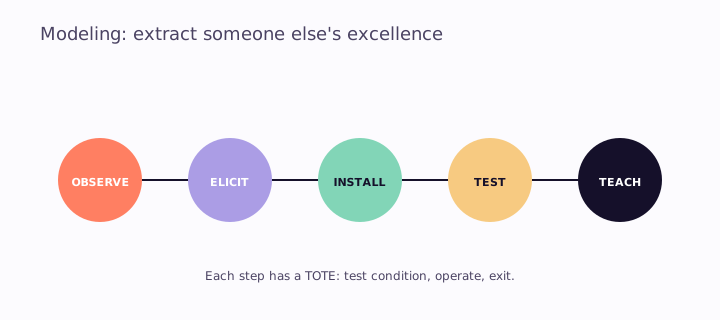
The modeling cycle
- Observe: watch the exemplar across many instances. Look for what they do consistently, including what they do not notice doing.
- Elicit: structured interviews that surface the internal sequence. "When you face X, what happens first inside? Then what?"
- Install: take the model into your own behavior. Run it deliberately even where it feels foreign.
- Test: check whether you produce comparable outcomes. If not, refine the model and try again.
- Teach: simplify the working model so it can be transferred to others.
The TOTE framework
Most strategies fit a Test - Operate - Test - Exit loop:
- Test the current condition against a desired condition.
- Operate to change the condition.
- Test again.
- Exit when satisfied.
Modeling someone's excellence often comes down to mapping their TOTE: what condition do they test for, what operations do they run, what is their exit criterion? Most people who fail at a skill are missing one of these four.
The strategy elicitation question set
Standard questions modelers ask:
- "How do you know it is time to do this?" (entry test)
- "What happens first inside? What do you see, hear, or feel?" (initial representation)
- "What happens next?" (sequence)
- "How do you know it is working?" (interim tests)
- "How do you know it is done?" (exit test)
- "What would tell you to stop and try a different approach?" (failure mode)
The answers form a sequence of internal representations and tests. The sequence is the strategy.
Common modeling applications
- Self-modeling: map how you produce your own best work, on the days it actually happens.
- Team modeling: identify the strategy of your highest performer and transfer it to the rest of the team.
- Capability transfer: senior practitioner models junior; junior models senior; gaps become teachable.
- Custom intervention design: model someone who has solved a specific problem to build a protocol for clients facing it.
Why most modeling fails
- Modeling the description, not the doing. Exemplars often describe what they think they do rather than what they actually do. Observation must accompany interview.
- Missing the unconscious steps. Most expert behavior includes steps the expert is not aware of. Skilled elicitation surfaces them.
- Stopping at one TOTE. Complex skills have nested TOTEs. Modeling only the outer one misses what makes the skill work.
- No installation phase. A model that is studied but not run is not a model; it is a description.
Frequently asked questions
Is NLP modeling the same as benchmarking?
No. Benchmarking compares outcomes; modeling extracts the internal strategy that produces the outcome. You can benchmark someone without modeling them and learn nothing transferable.
How long does it take to model someone?
A simple skill (a specific decision strategy) can be modeled in 5-15 hours of interview and observation. Complex excellence (top-of-field performance) often takes 100+ hours. Bandler and Grinder spent years on their original three exemplars.
Do you have to model someone in person?
Easier in person because you can observe micro-cues. Possible at a distance from recorded video plus structured interviews. Modeling from text alone produces shallow models.
Can you model yourself?
Yes. Self-modeling - mapping how you produce your own best work - is one of the highest-leverage uses of NLP. Most people have no model of their own competence and so cannot replicate it deliberately.
Is modeling ethical?
Generally yes, with consent. Modeling without telling the exemplar is closer to study than collaboration; the ethical line is whether you would be comfortable telling them what you are doing.
What is a TOTE?
Test - Operate - Test - Exit. A feedback-loop model NLP borrowed from cognitive psychology to describe any goal-directed sequence: test a condition, operate to change it, test again, exit when satisfied.
DIRECTORY
Find a modeling trainer
Modeling is taught in depth at Master Practitioner level and in specialized modeling programs.