What is rapport in NLP?
Rapport is a state in which two nervous systems track and respond to each other unconsciously. It is not friendliness, charm, or shared opinions. It is a perceptual and behavioral alignment that lets influence flow in both directions.
NLP treats rapport as the precondition for every other technique. A perfectly designed reframe fails if rapport is absent. A clumsy reframe lands if rapport is solid. The competence shows up in the rapport, not in the words.
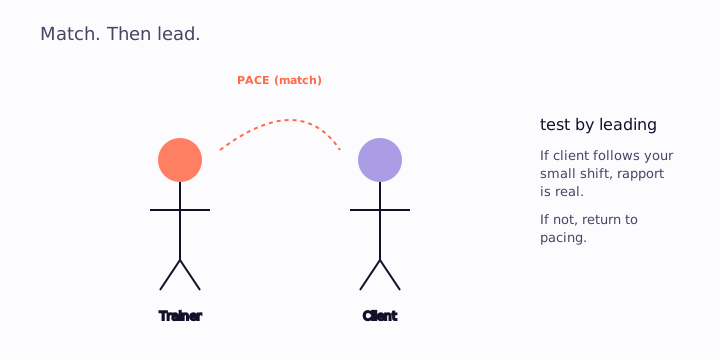
The pacing-leading cycle
Rapport is built in two phases:
- Pace: match what the other person is doing. Posture, breathing rate, vocal tempo, word choice. The match does not have to be exact; a softened, partial match is usually less detectable and more effective than a copy.
- Lead: once pacing has held for long enough that the other person's nervous system registers safety, make a small shift - sit slightly differently, slow your speech, deepen your breathing. If they follow, you have rapport and can lead. If they don't, return to pacing.
What to pace
Posture and gesture
Mirror the broad lines of how the person sits or stands. Cross-mirroring (your right matching their left) is more natural than direct mirroring and harder to detect. Mirror gesture frequency, not specific gestures.
Breathing
One of the most powerful pacing channels and the hardest to detect. Match the rate; you do not need to match the depth exactly. With practice you can shift your breath rate gradually and bring the other person's with you.
Voice
Tempo, volume, pitch range. A loud, fast speaker paired with a quiet, slow listener feels lectured. Match the tempo first; volume second; pitch range third.
Predicates
If they say "I see what you mean" (visual), respond with "I see that too" not "I hear what you're saying" (auditory). Predicate matching is one of the fastest rapport accelerators in NLP.
Emotional tone
Match the emotional register before adjusting it. Greeting an upset person with cheerful energy is a rapport failure; meeting their tone first and then gradually leading toward steadiness is the move.
Common rapport mistakes
- Mimicry. Direct copying reads as mockery. Mirror the pattern, not the move.
- Pacing only the visible. Posture matching without breath or voice matching is shallow. Breath does most of the unconscious work.
- Leading too early. If you try to lead before rapport is real, the other person snaps back to their own pattern and you lose the rapport you almost had.
- Holding rapport with content you should challenge. Pacing the words of a destructive belief installs it deeper. Pace the person, not the content.
- Forgetting to break rapport. When the work is done, returning to your own pattern signals the shift. Without the break, the session never properly ends.
Frequently asked questions
Is mirroring manipulative?
Mirroring done well is closer to listening with the body than to manipulation. It signals attention and shared rhythm. Mirroring done badly (mimicry, mechanical copying) reads as mockery and breaks rapport faster than not mirroring at all.
How long does it take to establish rapport?
With a willing person, rapport can establish in 1-3 minutes. With a guarded or skeptical person, 10-15 minutes. With actively hostile, you may need to address the hostility directly before any rapport is possible.
Can you have rapport with someone you dislike?
Yes, and you may need to. Rapport is a state of mutual responsiveness, not affection. Skilled negotiators, hostage mediators, and family-systems therapists hold rapport with people they would not invite to dinner.
How do you know rapport is real?
Test by leading. Make a small posture or tempo shift; if the other person follows without noticing, rapport is real. If they don't, pace more first.
Is rapport the same as charisma?
No. Charisma is one-directional and individual. Rapport is two-directional and relational. Some highly charismatic people are bad at rapport because they don't notice when they have lost it.
Can rapport be built online?
Yes, though more slowly. Voice tempo, language pacing, and shared predicates all work. Video mirroring is harder than in person; voice-only rapport is often easier because there is less to misread.
DIRECTORY
Find a trainer who teaches rapport in depth
Rapport is foundational. A trainer who can read and demonstrate it is worth more than one who only describes it.