What is the meta model?
The meta model is a structured set of questions designed to bring vague language into specificity. The premise: most human distress runs on imprecise descriptions of reality - deletions, distortions, and generalizations that the client has accepted as fact. The meta model challenges each type with a specific question that recovers the missing material.
Developed by Bandler and Grinder in the early 1970s, the meta model draws from transformational grammar and the questioning patterns of Virginia Satir and Fritz Perls. It is published in their first book, The Structure of Magic (1975).
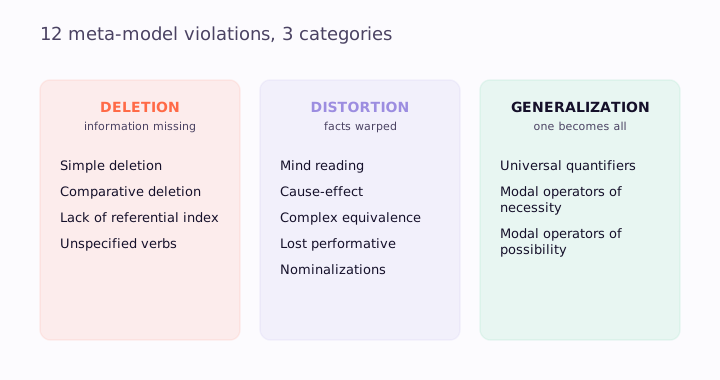
The three categories
1. Deletion (information missing)
- Simple deletion: "I am upset." -> "About what specifically?"
- Comparative deletion: "It is better this way." -> "Better than what?"
- Lack of referential index: "They don't respect me." -> "Who specifically?"
- Unspecified verbs: "She rejected me." -> "Rejected you how specifically?"
2. Distortion (facts warped)
- Mind reading: "He thinks I am incompetent." -> "How do you know?"
- Cause-effect: "Her tone made me anxious." -> "How specifically does her tone cause your anxiety?"
- Complex equivalence: "If she loved me, she would call." -> "How does calling mean love specifically?"
- Lost performative: "It is wrong to ask for help." -> "Who says it is wrong?"
- Nominalizations: "We have a communication problem." -> "Who is failing to communicate what to whom?"
3. Generalization (one becomes all)
- Universal quantifiers: "I always mess up." -> "Always? Every single time?"
- Modal operators of necessity: "I have to please everyone." -> "What would happen if you didn't?"
- Modal operators of possibility: "I can't speak in public." -> "What stops you?"
How meta-model questions work in practice
The questions do three things at once:
- Recover information the client deleted from their own awareness.
- Loosen frozen generalizations by surfacing counter-examples.
- Make the problem workable by moving it from abstraction to specifics.
Often a single well-aimed meta-model question dissolves what looked like a complex problem. "I have to please everyone" sounds insoluble. "What would happen if you didn't?" usually surfaces a specific fear that is much smaller than the generalization implied.
How to use the meta model without breaking rapport
- Pace before you challenge. Mirror the client's predicates and feeling first. Cold meta-modeling reads as interrogation.
- Soften the form. "I want to understand more about that. When you say 'always', is there ever a time it isn't true?" is gentler than "Always? Every time?"
- Be selective. Most sentences contain three or four violations. Ask the one whose answer will move the work, not all four.
- Listen to the answer. The point is the information that surfaces, not your demonstration of skill.
When the meta model is the wrong tool
- Mid-emotion. A client in acute distress needs to be heard, not questioned for precision.
- Identity-level statements without preparation. "I am unlovable" is a generalization the meta model can address, but only after rapport is firmly established.
- When the client already has the information. If they know what is specific, asking is annoying. Move on.
Frequently asked questions
Is the meta model intrusive?
It can be, if overused. Asking 'who specifically?' to every sentence interrogates the client. Use it surgically - one well-placed meta-model question often does more than ten.
What's the difference between the meta model and Socratic questioning?
Both use questions to surface assumptions. Socratic questioning aims at logical clarity; the meta model aims at recovering specific deleted, distorted, and generalized information in client language. Different goals, similar mechanics.
How many violations are in the meta model?
The classical list has 12 well-formed violation types in three categories: deletion (4), distortion (5), generalization (3). Different schools extend or contract this list.
When should you not use the meta model?
When the client needs to be heard before they can think. Meta-modeling someone mid-emotion can feel cold and rupture rapport. Use the Milton model first to pace, then meta-model when the client is regulated enough to receive specific questions.
Can the meta model damage rapport?
Yes, easily. The questions cut. Soften them with framing ('I want to make sure I understand') and only ask the questions whose answers will move the work forward.
Is the meta model evidence-based?
The patterns it addresses (vague language, mind-reading, overgeneralization) are well-documented in cognitive psychology as drivers of distress. The specific meta-model questions are pragmatic interventions that practitioners report working; controlled studies of the model as a whole are limited.
DIRECTORY
Find a meta-model trainer
The meta model is taught at every Practitioner certification and deepened at Master Practitioner level.