What is the Milton model?
The Milton model is a structured set of artfully vague language patterns Bandler and Grinder extracted from Milton Erickson's hypnotic work in the 1970s. Erickson did not use a formal "deepen the trance, now you are sleepy" induction style; he used permissive, conversational language that bypassed conscious objection by being unspecific in carefully chosen ways.
The Milton model gives those patterns a teachable vocabulary. Once you can recognize the patterns, you can use them deliberately - and notice when others are using them on you.
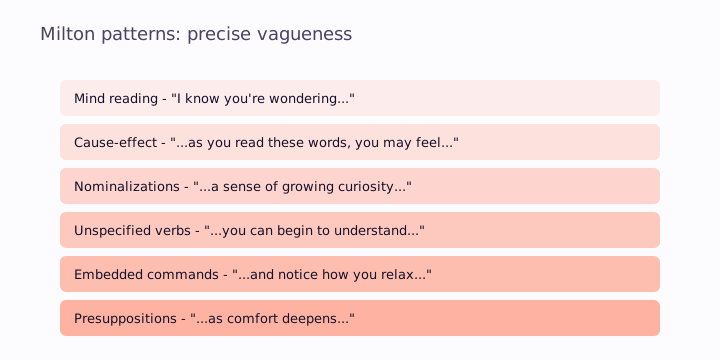
Core Milton patterns
Mind reading
"I know you're wondering whether this will work." Claims knowledge of internal state without sensory evidence. Creates rapport when accurate; produces resistance when wrong.
Cause-effect
"As you read these words, you may begin to relax." Asserts a causal link between something happening and a desired response.
Complex equivalence
"The fact that you are still listening means part of you is open to this." Asserts two things mean the same.
Presupposition
"Before you decide to make this change..." The decision is presupposed; only the timing is open.
Unspecified verbs
"You can begin to understand..." 'Begin' and 'understand' are vague enough that the listener fills in the specifics.
Nominalizations
"...a sense of growing curiosity..." 'Sense', 'curiosity', and 'growing' freeze processes into things and invite the listener to construct their own meaning.
Embedded commands
"You might find yourself relaxing as we talk." The command 'relax' is hidden inside the sentence, often marked subtly by tone.
Universal quantifiers
"Everyone has the capacity for change." A statement broad enough that the listener cannot dispute it but specific enough to invite identification.
Modal operators of possibility
"You can let yourself notice..." 'Can' opens an option without imposing it.
How the Milton model is used in coaching
- State elicitation: "as you remember a time when you felt completely focused..." - presupposes the memory exists and is accessible.
- Reframing under resistance: a meta-model question may produce defensiveness; the same content in Milton form often slips past.
- Resource installation: "you have probably already begun to notice..." installs the experience by presupposing it.
- Transitions: shifting from intake to intervention without an abrupt break.
How the Milton model is used outside coaching
The patterns appear in advertising copy, political speeches, sales scripts, religious texts, and skilled negotiation. Recognizing them is a defense as much as it is a skill. Most professionally written persuasive language uses some Milton patterns implicitly; reading it deliberately reveals where the suggestion is happening.
Ethics
The Milton model is power. Used to ease a client through resistance toward an outcome they chose, it is empowering. Used to install a meaning the client did not endorse, it is manipulation. Practical ethical tests:
- Direction of intent: are you working toward the client's stated outcome or yours?
- Consent: would the client agree with what you are doing if it were explained plainly?
- Reversibility: could you also use the patterns to help them undo the change?
Frequently asked questions
Is the Milton model manipulative?
It can be. Used to ease a client through resistance toward an outcome they chose, it is empowering. Used to install a meaning the client does not endorse, it is manipulation. The line is consent and direction of intent.
Does Milton-model language require formal trance?
No. The patterns work in normal conversation. Most working applications happen in light absorbed states, not stage-hypnosis trance.
Is Milton model the same as Ericksonian hypnosis?
It is the linguistic skeleton extracted from Erickson's practice, simplified for teaching. Full Ericksonian hypnotherapy is a much larger field that includes induction, deepening, utilization, and termination.
Can I use Milton patterns in writing?
Yes. Marketing copy, speeches, and articles often use Milton patterns implicitly. Explicit Milton-model writing is recognizable by its pacing, embedded suggestions, and artful vagueness.
What's the relationship between the Milton model and the meta model?
Inverses. The meta model uses precise questions to recover deleted, distorted, and generalized information. The Milton model uses deliberate deletion, distortion, and generalization to bypass conscious resistance. Same dimensions, opposite directions.
How long does it take to learn?
The patterns can be memorized in a weekend. Using them naturally in a session takes 6-18 months of supervised practice. The patterns are easy; the timing and ecology are hard.
DIRECTORY
Find a Milton-model trainer
Most certified Master Practitioners teach the Milton model in depth.