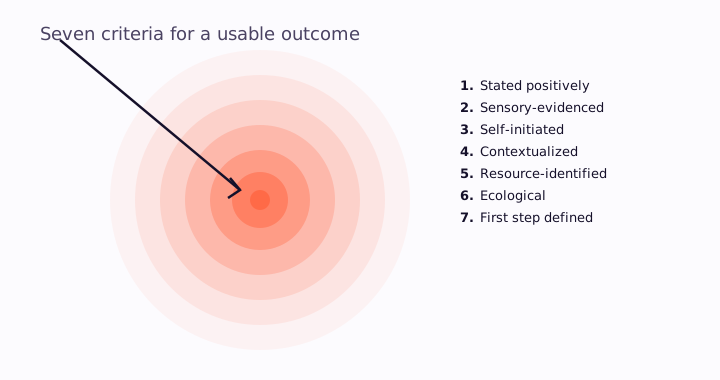
The seven criteria
- Stated in the positive. What you want, not what you don't. "I want to be confident speaking to groups", not "I don't want to be nervous".
- Sensory-evidenced. What will you see, hear, and feel that tells you you have it? Specific enough that another person could verify.
- Self-initiated and maintainable. Within your control. Depends on your actions, not on what someone else does.
- Contextualized. When, where, and with whom. "Always" and "everywhere" are usually red flags.
- Resource-identified. What internal and external resources will you need? What do you have? What do you lack?
- Ecological. Good for the whole system - self, relationships, work, health. What will you lose by gaining this? Is the trade worth it?
- First step defined. The first concrete action - small enough to take this week.
The standard elicitation interview
Ask the client these questions in order:
- "What do you want?" - in positive terms only.
- "How will you know when you have it? What will you see, hear, feel?"
- "Where, when, and with whom do you want this?"
- "What is it within your power to do? What part depends on others?"
- "What resources do you have already? What do you need?"
- "What will having this give up? What might you lose? Is the trade worth it?"
- "What is the first thing you could do this week?"
The answers form a complete map. Where the client cannot answer cleanly, the outcome is not well-formed - and that is where the work needs to happen before any technique is applied.
Worked example
Starting goal: "I want to be less stressed at work."
- Stated positively: "I want to feel grounded and clear-headed during stressful periods at work."
- Sensory evidence: "I notice my breathing stays low and deep; my voice stays steady; I can list the next three actions without spiraling."
- Self-initiated: yes - depends on my own state, not on workload reducing.
- Context: during high-load weeks, in meetings, when reviewing tight deadlines.
- Resources: have - knowledge of state-management techniques. Need - a daily morning ritual to install the baseline.
- Ecology: trade - will require waking 20 minutes earlier; will reduce some flexibility. Worth it.
- First step: tomorrow morning, run a 10-minute breathing protocol before opening my laptop.
The shift from the starting goal to the worked outcome takes maybe 15 minutes of careful questioning. The execution becomes obvious.
Why outcomes fail
- Negative framing. "Stop procrastinating" gives the brain nothing to move toward.
- No sensory evidence. Without it, you cannot tell whether you are succeeding.
- Depends on others. Outcomes you do not control are wishes, not goals.
- No ecology check. The goal succeeds; the rest of life pays.
- No first step. A vague "I will work on it" is not a first step.
Frequently asked questions
How is this different from SMART goals?
SMART (specific, measurable, achievable, relevant, time-bound) is a planning checklist. Well-formed outcomes adds three NLP-specific criteria: sensory evidence, self-initiated control, and ecological fit across the whole system. A SMART goal can be perfectly formulated and still fail an ecology check.
What is the most-missed criterion?
Ecology. Most people set outcomes that conflict with other parts of their life and treat the conflict as motivation problems. The ecology criterion surfaces the conflict at the design stage.
Do you have to meet all seven criteria?
For high-stakes outcomes, yes - the time spent meeting all seven pays back in execution. For quick goals, the first four (stated positively, sensory-evidenced, self-initiated, contextualized) are the load-bearing ones.
What does 'self-initiated' mean exactly?
The outcome must depend on actions you can take. 'My partner stops criticizing me' is not self-initiated; 'I respond to criticism in a way I am proud of' is. The shift turns dependent outcomes into achievable ones.
How long does outcome setting take?
A full well-formed outcome interview runs 30-60 minutes for high-stakes goals. Worth the time - badly formed outcomes are why most coaching fails to produce results.
Can you have a well-formed outcome for someone else?
By definition no, because the self-initiated criterion fails. You can have a well-formed outcome about what you do in relation to them.
DIRECTORY
Work with a trainer who sets outcomes properly
Most experienced practitioners start with outcome work. Pick a trainer who runs the full interview, not just a goal-setting checklist.