What does 'ecology' mean in NLP?
Ecology in NLP refers to the systemic fit of a change: whether installing it leaves the rest of the client's life better, worse, or unchanged. Borrowed from systems thinking, the concept treats the person as one part of a larger system that includes relationships, work, health, and identity. A change that improves one part at the expense of another may not be worth installing.
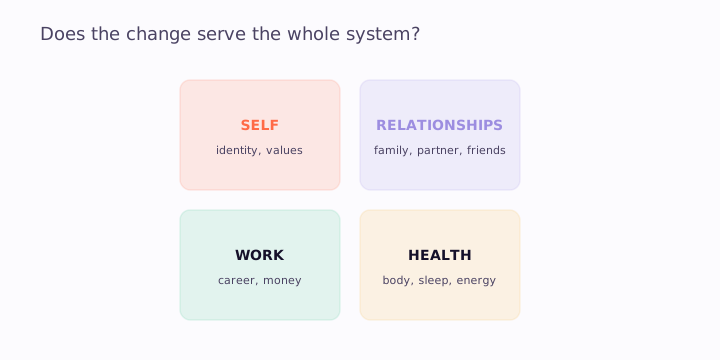
The four quadrants
- Self: identity, values, internal coherence. Does this change feel like 'me'?
- Relationships: family, partner, close friends. Will this affect anyone who depends on me?
- Work: career, money, professional commitments. What needs to shift to make room for this?
- Health: body, sleep, energy, mental load. Can my system sustain this change?
The standard ecology questions
- "If you get this outcome, what will you lose?"
- "What part of you might object to this change?"
- "How will this affect the people closest to you?"
- "What is the current behavior doing for you that the new behavior will need to do?"
- "What would have to be true for this change to be worth the trade?"
- "Is there any part of you that prefers the current state? What does that part want?"
What an ecology objection looks like
Objections are often non-verbal. A client says "yes, I want this" but their breathing goes shallow, their voice flattens, or they shift their gaze sideways. The verbal yes and the non-verbal no are an ecology signal. The next step is to ask directly: "Part of you isn't quite there yet. What is it saying?"
Verbal objections usually take one of three forms:
- "Yes, but..." - the 'but' points at the displaced concern.
- "What about [other person]?" - relationship-level ecology.
- "I'm not sure I'd still be me" - identity-level ecology.
When ecology checks change the intervention
A successful ecology check often modifies the planned change:
- "Quit smoking entirely by Friday" -> "Cut to 5 cigarettes/day for two weeks; install replacement state for the social-bonding function the smoking has been carrying."
- "Leave the marriage" -> "Have the conversation I have been avoiding. Decide afterward."
- "Become a morning person" -> "Test for two weeks; revisit if my evening creative time deteriorates."
The change still happens; it happens in a form the whole system can hold.
Frequently asked questions
When should you run an ecology check?
Before installing any significant change, and again after the technique to test integration. Also: any time the client says 'yes, but...' - the 'but' usually points at an ecology issue.
What if the ecology check reveals the goal is wrong?
Then you have done the work that needed to be done. Revising or dropping a goal that doesn't pass ecology is a successful session outcome, even if the original technique was never run.
How do you ecology-check a behavior change?
Ask: 'If you stop doing this behavior, what positive thing does it currently provide that needs to be provided another way?' Almost every persistent behavior is doing some legitimate work; the work has to be relocated, not just stopped.
Is ecology check the same as risk assessment?
Risk assessment looks for things that could go wrong externally. Ecology check looks for things the change will displace internally and in close relationships. Different but complementary.
Can ecology checks be skipped for small changes?
Yes for genuinely small changes. The trap is treating large changes as small. If you find yourself thinking 'this is obvious, why do an ecology check', that is usually when you most need one.
What if a part objects?
Listen to it. A part objection is information about what the change will cost. Either modify the change to accommodate the part's intention, or do parts integration before continuing.
DIRECTORY
Find a trainer who takes ecology seriously
Many trainers skip ecology. The good ones build it into the work from the first session.