What are the neurological levels?
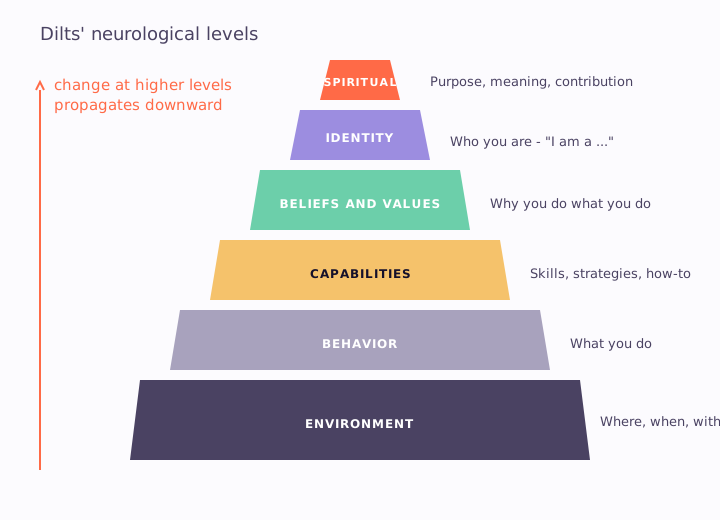
The neurological levels are six tiers Robert Dilts proposed in the 1980s as a way of organizing human experience hierarchically:
- Environment: where, when, with whom - external conditions.
- Behavior: what you do - actions.
- Capability: how you do it - skills, strategies.
- Belief and value: why you do it - what matters and what is true.
- Identity: who you are - "I am a ..."
- Spiritual (or purpose): what you serve - meaning, contribution, larger system.
Dilts adapted the model from Gregory Bateson's logical levels of learning. The name "neurological" reflects Dilts's claim that different levels engage different cognitive systems, not that they map to specific brain regions.
The propagation principle
Change at a higher level tends to reorganize lower levels automatically. Change at a lower level rarely propagates up.
Examples:
- A client who shifts identity from "someone trying to quit smoking" to "a non-smoker" finds the behavior change easier because the identity is no longer in conflict with it. Behavior follows.
- A client who only changes behavior (joins a gym, environment change) without belief or identity change typically reverts within months.
- A purpose-level shift ("I want my work to serve people in this specific way") often cascades through identity, belief, capability, behavior, and environment in a single arc.
Diagnosing the level
Listen for the level in the client's language:
| Level | How it shows up |
|---|---|
| Environment | "My office is too distracting", "There aren't good people in this town" |
| Behavior | "I keep procrastinating", "I don't follow through" |
| Capability | "I don't know how to negotiate", "I can't manage time" |
| Belief | "Money is hard to make", "People don't want to hear from me" |
| Identity | "I'm not the kind of person who leads", "I'm not creative" |
| Spiritual | "I don't know what I'm here for", "Nothing I do seems to matter" |
The level in the client's language is usually where the problem lives - but not always. A client may complain at the behavior level when the actual block is at belief or identity. Skilled diagnosis tests this: if a behavior intervention fails repeatedly, the real level is higher.
Matching intervention to level
- Environment: change the surroundings. Move the desk. Change the company.
- Behavior: habits, routines, anchoring, swish patterns.
- Capability: skill-building, modeling, deliberate practice.
- Belief: belief-change protocols, reframing, evidence inventories.
- Identity: identity statements, embodied identity work, reference experiences.
- Spiritual: purpose work, values clarification, life-direction interviews.
The logical level alignment exercise
A widely-taught exercise: have the client physically walk through six locations on the floor, one per level, declaring at each ("In this environment... behaving this way... using these capabilities... believing this... being this person... in service of this purpose"). The exercise surfaces incongruence between levels and often produces alignment without further intervention.
Frequently asked questions
Are the neurological levels actually neurological?
The name is metaphorical. The levels do not correspond to specific brain regions. The model is a logical hierarchy borrowed loosely from Gregory Bateson's logical levels, not a neuroanatomical claim.
Why does higher-level change propagate downward?
Because higher levels organize lower ones. An identity shift ('I am a runner') reorganizes capabilities (training), behaviors (waking early), and environment (a road bike in the garage). A behavior change without identity support tends to revert.
How do you intervene at the identity level?
Through deliberate identity work: imagining yourself as the new identity in vivid detail, surfacing the beliefs that match that identity, and acting from the identity rather than toward it. The work is slower than behavior change but tends to last.
Is the spiritual level religious?
Not necessarily. In Dilts's framing, 'spiritual' refers to purpose, meaning, and contribution - questions about why you exist and what you serve. Religious frameworks fit there, but so do secular ones.
Which level should I intervene at first?
Match the level to where the problem actually lives. Environment problems need environment changes. Identity problems do not respond to environment changes. Diagnose first.
Is this model evidence-based?
It is a pragmatic framework, not an empirically validated one. Practitioners report it produces better diagnostic and intervention choices than no framework; controlled studies are limited.
DIRECTORY
Work with a trainer who uses neurological levels
The model is taught at Practitioner level and applied throughout coaching practice.