What is reframing in NLP?
Reframing is the conscious construction of an alternative interpretation for a situation, behavior, or experience. The original facts remain. What changes is the meaning the person assigns to them, and as the meaning shifts, the emotional response shifts with it.
The technique works because most human distress is not about events themselves but about the meaning we attach to events. Two people can experience the same job loss; one frames it as failure and collapses, the other frames it as redirection and rebuilds. The event is identical; the meaning is the lever.
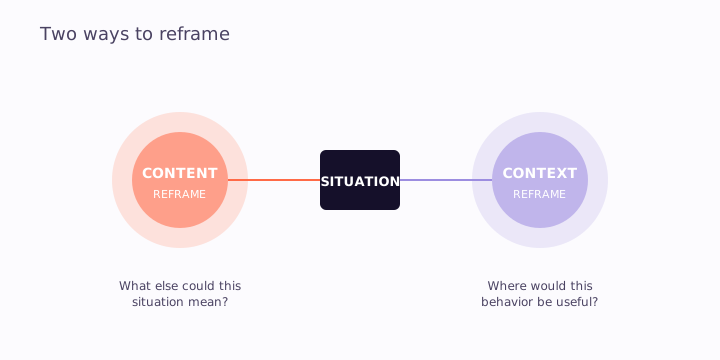
What is a content reframe?
A content reframe changes what the situation means. The question driving it is: What else could this mean?
Examples:
- "He never listens" -> "He is processing internally before responding."
- "She criticizes everything" -> "She has high standards and assumes you can meet them."
- "I keep failing at this" -> "I am gathering specific data about what does not work."
Content reframes work fastest when the new meaning is generated by the client rather than imposed by the coach. The coach's job is to ask the question that opens the search; the client's job is to find a meaning they can actually believe.
What is a context reframe?
A context reframe changes the context in which a behavior is evaluated. The behavior stays the same; the setting moves. The driving question is: Where would this behavior be useful?
Examples:
- "My kid is too argumentative" -> "Those debate skills will serve him in law school."
- "I am too detail-obsessed" -> "That trait is what makes you trustworthy with high-stakes work."
- "She is too aggressive in meetings" -> "In a sales negotiation, that drive closes deals."
Context reframes are particularly useful for traits a client wants to disown but cannot easily change. By relocating the trait to a context where it produces value, the client stops fighting it and can choose when to deploy it.
When should you use each type?
- Use a content reframe when the client has frozen a single, painful meaning around an event ("this means I am unlovable").
- Use a context reframe when the client is stuck judging a behavior or trait that has no inherent moral content ("I am too sensitive").
- Use neither when the situation involves genuine, ongoing harm. Reframing harm prolongs it. Address the harm directly.
How do you reframe limiting beliefs?
Limiting beliefs ("I am not good with money", "I am not the kind of person who can lead") need a slightly longer process than situational reframes. The standard sequence:
- Surface the belief precisely. Get the client to state it in one sentence.
- Identify the experiences that built it. Usually 2-4 specific events.
- Generate counter-examples. Times the belief did not hold true. There are almost always some.
- Construct a more useful belief that incorporates both the original data and the counter-examples.
- Test in imagination. Future-pace the new belief into upcoming situations.
- Install with anchoring if needed.
What are common reframing mistakes?
- Imposing the reframe. A reframe the client cannot believe is just an argument they will resist.
- Reframing too fast. If the client has not finished feeling what they came in feeling, reframing reads as dismissal.
- Reframing actual harm. Some situations need to be addressed, not reinterpreted.
- Generic optimism. "Everything happens for a reason" is not a reframe; it is a platitude.
- Skipping the test. Without future-pacing, the new frame stays in the session room.
Frequently asked questions
Is reframing the same as positive thinking?
No. Positive thinking generates optimism about the same interpretation. Reframing changes the interpretation itself - what the situation means. It does not deny reality or force optimism; it opens a wider range of valid interpretations.
Can reframing make me accept things I shouldn't?
Bad reframing can. Good reframing expands options and maintains personal values; it does not override them. If a situation involves genuine harm, the appropriate response is to address the harm, not reframe it.
How quickly does a reframe take effect?
When the new meaning is generated by the client and fully accepted, the effect can be immediate. For deeper or more identity-level interpretations, the new frame may need reinforcement over several sessions.
Can you reframe trauma?
Carefully and not as a first move. Reframing trauma without first stabilizing the client and processing the somatic load can produce a fragile cognitive shift that does not hold. Refer to a licensed trauma specialist when in doubt.
What's the difference between content and context reframes?
A content reframe changes what the situation means ('he's not stubborn, he's principled'). A context reframe changes where the same behavior would be useful ('that persistence would be invaluable in negotiation'). Both leave the facts intact.
Is reframing manipulative?
It can be. Used to dissolve a client's own limiting frame at their request, it is empowering. Used to install a meaning the client does not endorse, it is manipulation. The line is consent and direction of intent.
DIRECTORY
Find a certified reframing trainer
Reframing is taught at every Practitioner certification. Search trainers who use it as a core method.