What is timeline therapy?
Timeline therapy is the deliberate use of the client's internal timeline to reorganize past memories and pre-frame future events. The premise is that the unconscious mind stores time spatially: past events have locations, future events have locations, and the relationship between them can be worked with directly.
The technique was formalized by Tad James in the 1980s, drawing on observations Bandler and others had made about how clients describe time. James trademarked the specific protocol and built a certification body around it; the broader category - timeline work without the trademark - exists across most modern NLP schools.
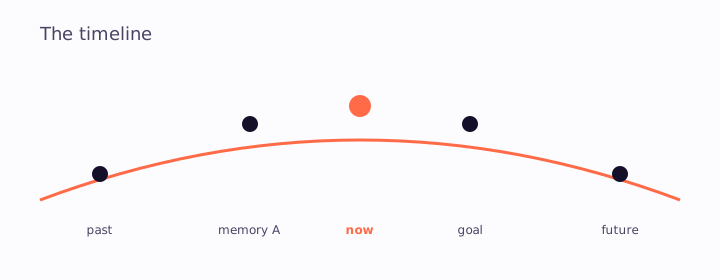
In-time vs through-time
NLP distinguishes two timeline orientations:
- In-time: the timeline runs through the body. Past is behind, future is ahead. In-time clients tend to be more present-focused and lose track of time during absorbing activities.
- Through-time: the timeline is visible in front of the person, often left-to-right. Through-time clients tend to be more time-conscious, organized, and able to plan in detail.
Neither is better. Knowing which orientation a client uses tells you how to set up the visualization.
Core techniques
Releasing negative emotion
The practitioner identifies an event where an unwanted emotion (anger, fear, sadness, hurt, guilt) became installed. The client travels imaginatively above the timeline to a point before that event, looks down at the event, and accesses learnings from a position of safety. Repeated for chained instances, this often produces a noticeable decrease in the emotional charge of the original event.
Installing resources
The client identifies a past moment where they needed a resource they did not have. They access the resource in the present (calm, courage, focus), travel along the timeline to that past moment, and install the resource there. The reframed memory often becomes a new reference point.
Future-pacing
The client builds a desired outcome, places it on the timeline at a specific future point, and walks the timeline backward to identify the actions required to get there. This produces a concrete plan with embodied commitment, not just an abstract goal.
What to expect in a session
A typical full session runs 60-120 minutes:
- Intake: identify the specific emotion or event to work with.
- Timeline elicitation: locate the client's internal timeline (in-time or through-time).
- Identify the root: travel to the first or earliest instance of the pattern.
- Reframe at the root: from above the timeline, extract learnings the unconscious needed from that event.
- Sweep forward: clear subsequent instances of the same pattern using the new perspective.
- Future-pace: install the changed state into imagined upcoming situations.
- Integration: bring the client back to present time and test.
What can go wrong
- Working too deep too fast. Diving for an early memory of complex trauma without stabilization can destabilize the client.
- Confabulation. Memories surfaced under suggestion are not reliable historical reports. Frame the work as state change, not history recovery.
- Confusing in-time and through-time. Trying to drag a through-time client into in-time visualization fails; calibrate first.
- No future-pacing. Work that does not get walked forward into upcoming situations tends not to generalize.
Frequently asked questions
What is the difference between timeline therapy and timeline work?
'Timeline therapy' is a trademarked methodology developed by Tad James in the 1980s. 'Timeline work' is the broader category of NLP techniques that use a person's internal timeline as the working space. The mechanics overlap; the branding does not.
Is timeline therapy regulated?
Not as therapy, despite the name. It is delivered as coaching in most jurisdictions and certified through private bodies (Tad James Co. and others) rather than clinical licensing boards.
Does timeline work require hypnosis?
Most timeline work runs in a light absorbed state, not formal hypnosis. The client stays alert enough to give feedback and direct the work.
Can timeline work be used for trauma?
Some practitioners use it for trauma; most experienced trainers recommend referring complex trauma to a licensed clinician and using timeline work for less severe issues. Done badly, it can destabilize.
How long does a timeline session take?
Typical full timeline interventions run 60-120 minutes. Brief future-pacing on a timeline can be done in 10-15.
Is timeline therapy evidence-based?
It has accumulated case reports and practitioner testimonials but limited randomized controlled trial evidence. Treat it as a pragmatic technique with reasonable safety in skilled hands, not as a clinically validated intervention.
DIRECTORY
Find a certified timeline trainer
Tad James Co., ABNLP, and several other bodies certify timeline-therapy specialists.